– SURSĂ DE TEXTE FUNDAMENTALE, CĂRŢI, CURSURI, LECŢII, ÎN LIMBA ROMÂNĂ –
Autor: arhiprofesor
Rene Guenon spunea candva ca numai prostii cred ca se pot initia singuri. Intotdeuna ai nevoie de un maestru. Dar cartea ramane o sursa de imbogatire a cunostintelor noastre fara de care nici maestrii nu-si pot desavarsi lucrarea. Biblioteca de arhitectura este pentru un arhitect tot atat de importanta cat experimentarea in concret a trairii fiecarui spatiu arhitectural.
1) “And Jacob went out from Beer-Sheba, and went toward Haran.” Rabbi Hiya said, “And Jacob went out” means sunrise, like the sun that comes out. Beer-Sheba is Bina, from which ZA receives his light. Haran is Nukva, who receives the light of the sun, ZA. And he says, “The sun rises and the sun sets, and hastens to its place it rises there.” “The sun rises” is Jacob, ZA, when he was in Beer-Sheba, Bina. “And the sun sets,” when he went to Haran, is NukvadeZA. It is written, “And he came to a certain place and spent the night there, for the sun had set.” “And hastens to its place it rises there,” is as it is written, “And [he] lay down in that place.” The Nukva is called “a place,” and to there he hastens and shines.
2) Even though the sun shines to the whole world, his journeys are only on two sides; he walks to the south and turns to the north, since south is the right line and the north is the left line. The sun extends and comes out every day from the east side, which is its own essence, Tifferet, and walks toward the south side, to the right line, Hesed. Afterwards, it turns toward the north, to the left line, Gevura, when it is mingled with the illumination of the two lines. From the north side, he walks toward the west, Nukva, as it is written, “And went toward Haran.” The illumination implied in the words, “And Jacob went out” is complete illumination, comprising both lines—right and left, Hochma and Hassadim together.
3) However, he went out from the land of Israel, as it is written, “And Jacob went out from Beer-Sheba,” which is the complete Nukva, called “the land of Israel,” and went to another authority, as it is written, “And went toward Haran,” which is outside the land of Israel, to the domain of the Sitra Achra. He went out through the east, the middle line, which includes both lines, right and left, as it is written, “And Jacob went out from Beer-Sheba,” which is Shmita [remission], the Nukva.
From the upper depth—Bina—he took the light that shines and goes to the west. In other words, he took that light which was setting in the west, which is the left line without the right, as it is written, “And went toward Haran,” which is a place where there are Din [judgment] and Haron [anger], the domain of the Sitra Achra. This is so because the illumination of the left without the right is regarded as the Sitra Achra. It wanes and sets until it is completely concealed due to the absence of the light of Hassadim of the right line, for Hochma cannot shine without Hassadim.
It turns out that Rabbi Shimon disagrees with Rabbi Hiya on four matters. 1) “And Jacob went out” is not sunrise, but rather going out from one domain to another. 2) During the exit from the south and the north he was included only with illumination of the left, without the right. 3) Beer-Sheba is not Bina, but rather the complete Nukva when she is attached to the east. 4) Haran is not the NukvadeZA, but rather the domain of the Sitra Achra.
4) Rabbi Yosi interprets the verse about the exile. In the beginning, light would come down from the upper depth, Bina, and Jacob, who is ZA, would take it and leave, and impart upon Beer-Sheba, which is the Nukva that is built of AVI. Jacob was shining from AVI and complemented that Beer [well] to its perfection. During the exile, he travels from Beer-Sheba and goes to Haran, meaning the Creator’s Haron Af [wrath], which is the degree of evil, Malchut deKlipot. It turns out that he, too, disputes Rabbi Hiya on those four matters.
5) But when the sun, ZA, goes to the west, to the Nukva, the west is called “the place of the sun,” “his throne,” which is the place where the sun is present, as it is written, “And hastens to its place it rises there.” He goes to that place to shine upon it, and he takes all the lights—from the right line and from the left line—and gathers them to him, meaning bestows them upon the Nukva.
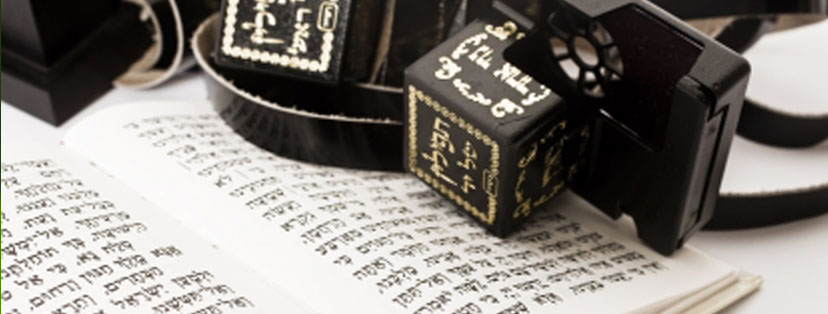
6) The Creator, ZA, who wears Tefillin, takes all the upper Ketarim [plural of Keter], which are upper Aba and upper Ima, meaning the Mochin of Hochma and Bina. Those are two portions: “Sanctify unto Me all the first-born,” and “And it shall be when the Lord shall bring you.” “Sanctify” is the Mochin of upper Aba, Hochma. “And it shall be when the Lord shall bring you” is the Mochin of upper Ima, Bina. These are the head Tefillin, GARde [of] Tefillin, Yod–Hey, called Rosh [head], GAR. And after he took the Mochin deAVI, Yod–Hey, he takes the right and left of MoachhaDaat, which are two portions: “Hear O Israel,” and “And it shall come to pass, if you will hear,” which are the Vav–Hey. By that, ZA takes all the Mochin HBHG, which are the four portions, called “the Tefillin of the Creator.”
By that, Rabbi Hiya proved to Rabbi Shimon that it cannot be said that “And Jacob went out from Beer-Sheba” means that he took only the illumination of the left without right, as Rabbi Shimon says, since Divinity is called “a place” when he imparts upon her from all the lights. But here it is written, “And he came to a certain place,” meaning that Jacob illuminated all the lights to her, and not just the illumination of the left.
By that, he contradicts all the words of Rabbi Shimon because it means that “And Jacob went out” does not mean that he went outside of the domain of Kedusha [holiness] into the domain of the Sitra Achra, as Rabbi Shimon says, but that it is a complete sunrise. After all, he illuminated from all the lights together, which is Kedusha.
Also, Beer-Sheba, Bina, is the source of the east side, which contains all the lights together. And Haran is the NukvadeKedusha [Nukva of holiness], who receives that perfection, and not the Sitra Achra, according to Rabbi Shimon’s words. It turns out that by that, he refuted all of Rabbi Shimon’s words.
However, in Item 8, below, Rabbi Shimon replies to him that Haran is the foreskin, but afterwards Jacob returned to the NukvadeKedusha, of whom it is written, “And he came to a certain place.” This settles everything.
7) Tifferet Israel [the glory of Israel], ZA, takes all four Mochin [lights] HBTM. When the assembly of Israel was drawn above to Bina, she takes everyone along with her, too, like ZA, and includes the male world of the Creator, Bina, as well as the female world of the Creator, meaning her own essence. And as all the lights come out from the world of Bina, the world of the Nukva takes them all, as well, since now the Bina is equal to the Nukva because she rose to her and clothed her, and a lower one that rises to a higher one becomes like him.
For this reason, Beer-Sheba is a Yovel [jubilee], Bina, and Beer-Sheba is Shmita [remission], the Nukva, since the lights of Bina and Nukva are the same. This is why they are both called “Beer-Sheba.” Also, this sun shines only from the Yovel. This is why it is written, “And Jacob went out from Beer-Sheba,” meaning Bina, “And went toward Haran,” to the west, which is Shmita, the Nukva, since Beer-Sheba is Bina and Haran is Nukva.
8) But, “And Jacob went out from Beer-Sheba” is west, the year of Shmita, the Nukva, and “And went toward Haran” is a year of foreskin, since he went out of the domain of Kedusha into another domain because he fled from his brother. And when he reached Beit-El, a holy domain, it is written, “And he came to a certain place.” First, Jacob went out of the domain of Kedusha because he took illumination of the left without right. But in the end, he returned to Kedusha and was included in all the lights. And then it is said, “And he came to a certain place.
9) From which place? From the place of ZA, the Nukva.
10) “And he took one of the stones of the place” means that he chose precious stones, good gems, which are twelve high stones, beneath which are twelve thousand chiseled stones, and they are all called “stones.” This is why it is written, “Of the stones of the place,” and not, “The stones of the place,” which is Nukva.
The Nukva is called “a stone.” The degrees in her are called “good stones.” And because she receives from NHYdeZA, which are called “legs,” she is also called Margaliot [gems], from the word Margelotav [at his feet]. And the number twelve implies to Hochma, and ten to Hassadim, indicating to illumination of Hochma because it indicates that she is entirely mitigated in Bina and is fit for reception of the Hochma. Hence, after their inclusion in one another, there are only twelve Sefirot, Hochma, Bina, and Tifferet in each of her four Sefirot HBTM, and her own essence is missing because it was mitigated in Bina.
This is why they are four times three, which are twelve, and four times four, which are sixteen. And this is Solomon’s sea, which stands on twelve oxen. While the Nukva receives illumination of Hochma, she is called “a sea.” At that time, she stands on only twelve Sefirot, called “oxen,” meaning three to each direction and not four.
Also, her illuminations, which reach the worlds from Atzilut down, are also regarded as twelve. And since they are considered Hochma, they are thousands. Hence, they are twelve thousand stones.
And with respect to the illumination of Hassadim that dresses the Hochma, they are regarded as tens of thousands because ten thousand is Riboh [myriad], which indicates to illumination of Hassadim within which is Hochma. When they travel through the Masach below the Atzilut, they are carved off and become separated from the light of Atzilut, due to the Masach that ends the world of Atzilut. Below them, under the twelve stones in NukvadeAtzilut, there are twelve thousand and tens of thousands of chiseled stones, since the illuminations of Hochma is twelve thousand and the illuminations of Hassadim are tens of thousands.
Also, they are carved because they went through the Masach deAtzilut, which carves and separates them from Atzilut. They are all called “stones”: they are twelve degrees in her, herself, and they are her illuminations, which extend from her, twelve thousand and tens of thousands, and they are all called “stones.” This is why it is written, “Of the stones of the place,” to indicate that he took only those twelve stones that are in her, herself.
11) “And put it under his head,” of that place, the Nukva. “Under his head” refers to the four heads of the world, the four directions—south, north, east, and west, HBTM. It is written, “And from there it parted and became four heads.” He gave three stones to the north direction, three to the west direction, three to the south direction, and three to the east direction. And that place stands over them to be corrected in them, as it is written, “It stood upon twelve oxen.”
12) “And lay down in that place.” “Lay down” has the letters, VeYesh [there are] Chaf–Bet [twenty-two], which are twelve gems below, on which the Nukva stands, indicating to the Hochma in her. And all those degrees, which are on that place, are ten Sefirot, and this number indicates to the illumination of Hassadim in her. Thus, they are twenty-two, which implies to her perfection in both Hochma and Hassadim, since the bed has been corrected in twenty-two, ShaChav Ba [Hebrew: “laid in it,” but also, “That contains 22”]. Who laid in it? It is the sun, ZA. This is why it is written about Jacob, who is ZA, “And sat upon the bed,” since she is fit for him and for none other because she is the NukvadeZA. This is why, “And [he] lay down in that place.” And it is written about that, “The sun rises and the sun sets.”
139) When Isaac said to Esau, “And go out to the field and hunt game for me,” with a Hey [in the word “hunt” in Hebrew]. It should have said, “hunt,” without a Hey [the usual way of spelling it in Hebrew]. And Esau went out to hunt game so as to be blessed by Isaac, who told him, “And I will bless you before the Lord.” If he had said only, “I will bless you,” it would have been good. But since he told him, “Before the Lord,” at that time the Creator’s throne shook, for a serpent would come out of these curses and Jacob would remain in them.
The meaning of clothes: in Tzimtzum Bet [second restriction], after the bottom Hey rose to Bina and Bina received the Tzimtzum into her, ZON were separated from every Partzuf and two surrounding Kelim [vessels] were made of them, which are called Levush [clothing] and Heichal [palace]. Those are the MakifdeHaya [surrounding light of Haya] and the MakifdeYechida [surrounding light of Yechida]. ZA, which was separated from every degree after Tzimtzum Bet, became the clothes that extend the illumination of light of Haya. TheZohar calls them “clothes of Malchut,” meaning that they extend from the essence of Malchut before she was mitigated in Bina, from the ten Sefirot of Tzimtzum Aleph, which is ZA that was in the degree preceding Tzimtzum Bet.
The meaning of “hunt” [with a Hey]: The corporeal still, vegetative, animate, and speaking that extend from the spiritual still, vegetative, animate, and speaking in the upper worlds are four degrees in the Mochin, one atop the other. Mochin deVAK are called “still” and “vegetative,” Nefesh and Ruach. Mochin deGAR are called “animate,” and include beasts, animals, and fowl. These are three discernments in Mochin deGAR that a person extends, which are different from one another. And extension of these Mochin of the spiritual animals, which are GAR, is called “hunt.” There is hunt of holiness, of which it was said, “I will abundantly bless her provision,” and there is hunt of Sitra Achra, of which it was said, “A mighty hunter before the Lord.”
To extend GAR, the bottom Hey needs to be lowered from the Nikvey Eynaim to the Peh. At that time, AHPdeKelim return to the degree and the GAR of lights are drawn. This lowering is done by clothing oneself with clothes that are the MakifdeHaya from Tzimtzum Aleph, where the bottom Hey is in her place at the Peh. Hence, by the illumination of these clothes, he lowers the bottom Hey from the Nikvey Eynaim to the Peh and draws the GAR, which is the hunt [with the Hey]. Thus, the hunting is done by the clothes, as we said about Nimrod that he was hunting his game in them, and he would go out to hunt in them. This is so because he extends the GAR through the illumination of HayadeTzimtzum Aleph in the clothes.
And when he extends the GAR, he immediately brings the GARdeGAR back to their root, which is the slaughtering of the animal. Thus, the light of life departs it and he enjoys only the meat that remains after the slaughtering, which is VAKdeGAR that is received and remains in the lower one. This is the hunt of holiness, of which it was said, “I will abundantly bless her provision.”
But this is not so with the Sitra Achra, who eat raw organs, meaning they wish to receive the animals’ light of life, as well, which is GARdeGAR. It is said about it, “A mighty hunter before the Lord.” “Before” means the light of Panim [face/anterior], GARdeGAR, when they wish to hunt and to draw unto them, which were the acts of Nimrod and Esau.
The meaning of blessings is giving strength and dominance to the end of correction, which is the correction of Malchut deTzimtzum Aleph, whether in Jacob’s way, which is hunting of holiness, or in Esau’s way, which is hunting of the Sitra Achra, and perpetuate that way for all eternity. The great Zivug, which brings the end of correction, contains within it all the Zivugim and the levels that emerged one at a time throughout the 6,000 years. Their value compared to this Zivug is precisely equal to the value of the sum of all the details.
Also, all the MAN that rise to this general Zivug are the sum of all the deeds and sufferings that were in the world one after the other in all the individuals and in all the generations throughout the 6,000 years. This is the meaning of the words, “May God give you of the dew of heaven,” which is ZA, “And of the fatness of the earth,” which is the Nukva. This means that he blessed him to be rewarded with all the levels of Zivugim of ZON during the 6,000 years, so they will be included for you in the general Zivug that you will be awarded at the end of correction.
“And much grain and wine” means that all the Mochin, called “bread” and “wine,” will gather to you. “May peoples serve you” means that all the works that all the peoples will do will be for you. You will receive them and they will complement you in the general Zivug. And through them, you will be rewarded with the end of correction.
“And nations bow down to you” means that all the afflictions in the world will then receive the form of bows to you, and will be included in the MAN of this general Zivug for you.
“Be master of your brothers” means that your way will remain forever, and the way of your brother will be of assistance to you, like a servant who assists his master, and all that the servant acquires, his master acquires.
“And may your mother’s sons bow down to you.” The suffering that will be included in your brothers’ MAN will receive the form of bows to you.
“Cursed be those who curse you,” that is, anyone who disagrees with your way will be cursed.
“And blessed be those who bless you,” that is, anyone who admits and accepts your way will be blessed. And Isaac contemplated blessing Esau with them, for all of Jacob’s good deeds and all the torments he had suffered were only for Esau’s benefit at that time, so that Esau would be rewarded with the great Zivug of the end of correction, and so that his way will remain forever, the way of the hunting of the Sitra Achra.
“And go out to the field and hunt game for me,” with a Hey. The Hey is the essence of Malchut, Malchut deTzimtzum Aleph, which is her that he said he would hunt, meaning extend the GAR to her, which is called hunting [with a Hey]. This occurs only at the end of correction, in the general Zivug. Hunting with a Hey means extending the GAR of Tzimtzum Aleph. Hence, how have these clothes helped him, since they only help the GAR of Tzimtzum Bet? “Before the Lord” indicates GARdeGAR, the light of Panim, which is the hunting of the Sitra Achra, the hunting of Nimrod, of whom it is written, “A mighty hunter before the Lord.”
This is why the throne was shaken, since this hunting is the serpent’s inciting of Eve to the tree of knowledge, which brought the curses to the world. Moreover, Jacob would remain in them because the blessings determine Esau’s way forever, and Jacob would be subjugated to him as a servant to his master. Thus, Esau’s curses would be atop him and he would have no counsel. Now you can understand Isaac’s reply to Esau, “I have made him your lord,” since once he established Jacob as master, he had no further blessing for Esau.
Thus, how did Isaac wish to bless Esau and determine the way of the hunting for the Sitra Achra for all eternity? Divinity wished for Isaac to extend the blessings that belong to Esau, the GARdeGAR, which would be included in Jacob’s way, as it is written, “The voice is the voice of Jacob, but the hands are the hands of Esau.”
140) At that time, Michael came before Jacob with Divinity, and Isaac knew that. He saw the Garden of Eden with Jacob and he blessed him. When Esau entered, hell entered with him. Hence, “And Isaac was horrified with great dread,” since he previously thought that Esau was not from that side, which is why he started and said, “And I will bless him, too, and he will be blessed.”
141) For this reason, Jacob behaved with deceit and stubbornness, and brought blessings upon Jacob, who is like AdamhaRishon. And they were taken from the serpent, who is the lying lips, for he said many lies did many fraudulent deeds to seduce into eating the tree of knowledge, and to bring curses on the world. This is the reason why Jacob came with deceit and mislead his father, to bring blessings on the world and to take from the serpent the blessings that he had denied the world, an eye for an eye. It is written about him, “You are cursed more than all cattle.”
142) And the serpent remained in the curses and never departed them. And David said in the spirit of holiness, “What shall be given to you, and what more shall be done to you, you deceitful tongue?”
143) “Deceitful tongue,” since the serpent deceived Adam and his wife, and brought evil upon him and upon the world. Then came Jacob and took all those blessings that were his. He was considered AdamhaRishon and the serpent denied him the blessings, so now Jacob came and regained them, as prior to the sin of the tree of knowledge. It turns out that he took of his own.
“Sharp arrows of the mighty” are Esau, who bore a grudge against Jacob for those blessings, as it is written, “And Esau hated Jacob because of the blessing.”
144) “May God give you of the dew of heaven, and of the fatness of the earth,” from above and from below, which are ZON, united. This is so because the heavens are ZA and the earth is Nukva. “And plenty of grain and wine” are over the world, which is the angel Matatron. Upper Mochin are called “bread,” and “Plenty of grain and wine” mean upper Mochin, bread and wine.
145) “Peoples will serve you.” This was true when King Solomon ruled in Jerusalem. “And nations will bow down to you.” This will be true when the Messiah King arrives. Everything will happen when the Messiah King comes, as it is written, “And let all kings bow down before him, All nations serve him.”
146) The letters Hey–Vav–Hey are the meaning of faith. The Hey above is Bina, the Vav in the middle is Tifferet, and the Hey at the end is Malchut. It is known that in and of herself, Malchut is unfit for Mochin because there is Tzimtzum over her, so she does not receive direct light within her. But through her ascent and mitigation in Bina, she gains two Sefirot—Bina and Tifferet—that are suitable for reception of the great Mochin.
The higher meaning of faith, which is Malchut, is implied in the letters Hey–Vav–Hey, meaning the ascent of Malchut to the upper one, to Bina. The letters Hey–Vav–Hey are the faith, the Malchut, which are the Kelim by which faith, meaning Malchut, gains her ascension to Bina. The upper Hey is Bina, the Vav in the middle line is Tifferet, and the Hey at the end is Malchut. This means that these letters, Hey–Vav–Hey, imply the three Sefirot Bina, Tifferet, and Malchut that are included in the faith, which is Malchut, which then obtains the two Sefirot Tifferet and Bina, which are Hey and Vav, to receive the great Mochin in them.
And by receiving the great Mochin in the letters, Hey–Vav–Hey, she governs the seventy ministers and gives them away, meaning removes them from nourishing off her. This will occur when King David comes, since King David was rewarded with the mitigation in Bina and obtained these letters, Hey–Vav–Hey, and through them, subdued all his enemies.
All the blessings are said about the end of correction, after the Messiah King arrives and not before. This is so because as long as Israel break the words of Torah, the blessings cannot come true until the arrival of the Messiah, when they repent and sin no more.
147) “May God give you.” All those blessings were from the share of Jacob; he took from what was his. And Isaac wished to give those blessings that were truly Jacob’s share to Esau. For this reason, the Creator made Jacob take what was his.
Blessings mean giving strength for the end of correction, as it is written, “And go out to the field and hunt game for me,” with a Hey [in the word “hunt” in Hebrew]. This implies the correction of Malchut deTzimtzum Aleph, whether in Esau’s way or in Jacob’s way, to perpetuate that way forever.
It is known that because of the breaking of the vessels, 320 sparks fell from holiness to the Klipot [shells], and that afterwards the Emanator corrected some of them. And because of the sin of the tree of knowledge, they fell into the Klipot once more, and our whole work in Torah and Mitzvot is to take those 320 sparks out of the Klipot and bring them back to holiness. They are the MAN that we raise, which draw all the Mochin during the 6,000 years of the existence of the world. And when all 320 sparks are sorted through the Mochin that extend from them, the end of correction will come.
And the explanation to these 320 is this: eight Sefirot—in each of which were four Behinot [discernments] HBTM—broke from the ten Sefirot of Nekudim, called Daat, HGT, NHYM. Thus, they are thirty-two Behinot that fell into the Klipot—four times eight.
However, since the ten Sefirot deNekudim were mingled in one another in a way that each of them contained ten Sefirot, it turns out that thirty-two Behinot broke from those ten Sefirot, which are included in each and every Sefira [singular for Sefirot], as they are ten times thirty-two, which are 320 in Gematria. Thus you find that due to the breaking of the vessels and the sin of the tree of knowledge, 320 Behinot fell into the Klipot.
And know that not all 320 Behinot were given for work and for sorting, but only 288 of them, which are nine times thirty-two Behinot, from the first nine Sefirot. But the thirty-two Behinot of Malchut in them were not given for scrutiny. Also, there is no need to sort her. Rather, along with the completing of the sorting of the 288 sparks, these thirty-two sparks will be sorted out by themselves.
We already said that all the Zivugim of the 6,000 years are the general Zivug at the end of correction. This is so because after the sorting of all 288 sparks was completed, since they became MAN for Zivugim of ZON, by which all the Mochin come out one at a time during the 6,000 years, then came the great Zivug that gathers all the elements into one whole. And because of the magnitude of that illumination, the thirty-two sparks of Malchut were sorted and corrected, and these thirty-two sparks of Malchut are called “the stony heart.”
This is why it is said then, “And I will remove the stony heart out of your flesh.” Now you understand that when Isaac said to Esau, “And hunt game for me,” with a Hey, he was referring to those thirty-two sparks of Malchut, which are sorted out only by the 288 sparks that gather together into the general Zivug. And that gathering is explained in the words, “May God give you.”
The blessings for the end of correction are the sum of the elements of the 288 sparks that were sorted by the Zivugim one at a time during the 6,000 years. And by gathering them, the correction was completed. And these Zivugim and the Mochin came out only in Jacob’s part, since he is the middle line that unites the two lines, right and left, in one another during his ascent to Bina. Then, since three came out of one, one is rewarded with those three, and this is the order by which all the Mochin deZON and the souls of the righteous appear.
And Esau has neither a share in those Mochin nor desire for them. Thus, all those blessings were Jacob’s share.
Isaac wished to bless Esau with them so that once the stony heart is corrected through Jacob, this fear in the form of, “If he is not rewarded, he is evil,” will not be anymore, since everything will be corrected. And henceforth, Esau could extend from above downwards as he wished, without any fear. It turns out that the righteous prepares and the wicked wears, since through the 288 sparks that Jacob sorted, by which the stony heart was sorted out from the Klipot, and evil has been removed from the world, he thus prepared for Esau to be able to extend through it in impurity, from above downwards.
It follows that Esau inherits all of Jacob’s labor, that your brother works and you receive all the gain, since all that the servant acquires, his master acquires. Isaac wished to tell this to Esau, and Jacob received those blessings because they were his. And he became the master of his brother Esau, as it is written, “[the wicked] may prepare it, but the just will wear it,” and all that Esau acquired, Jacob acquired.
148) When that serpent brought curses on the world and the land was cursed, it is written, “Cursed is the ground because of you,” meaning you will not bear proper fruit. Opposite that, Jacob was blessed after the coming of the Messiah, after the sin of the tree of knowledge is corrected. “And of the fatness of the earth” means that it will return to its perfection.
And for the curse, “In toil you will eat,” he was correspondingly blessed by the dew of the heavens. And against the curse, “Both thorns and thistles it shall grow for you,” he was blessed with “Plenty of grain and wine.” And against the curse, “By the sweat of your face you will eat bread,” he was blessed with, “Peoples will serve you and nations will bow down to you,” meaning that they will till the ground and engage in the works of the field, as you say, “And foreigners will be your farmers and your vinedressers.” And Jacob took everything, one opposite the other, for each blessing corresponded to one curse in the tree of knowledge. Thus, he took from his own.
And the Creator made Jacob take these blessings and adhere to his place and his share. And Esau adhered to his place and his share. And the blessings were said about the end of correction, since then the sin of the tree of knowledge will be corrected and it will be possible to be awarded a blessing opposite a curse, which is not so before the sin of the tree of knowledge is corrected.
150) The blessing of Esau is not like the blessing of Jacob. It is written in regards to Jacob, “May God give you.” And regarding Esau, it is written, “Shall be your dwelling,” but God is not mentioned in the blessing, for there was no holiness in it. It is written in Jacob, “of the dew of heaven, and of the fatness of the earth,” while in Esau it writes, “From the fatness of the earth and from the dew of heaven,” where the earth precedes the heaven.
And there is a great difference between the degrees, for in Jacob’s, it is written, “May God give you of the dew of heaven,” the upper dew, which is the abundance that extends from AtikYomin, called “the dew of the heaven,” the dew of the heaven above. This is the dew that extends in the degree of heaven, ZA, from which it is poured to the field of holy apples, Malchut. And then it is said about her, “And of the fatness of the earth,” the land of the living above, of Malchut when she robes the Bina that is called “the living God.” This is why at that time Malchut is called “the land of the living.” And Jacob inherited the blessing in the land above, Malchut, and in the heaven above, ZA.
And Esau’s blessing was in the land below and in the heaven below, in this world. Jacob was blessed up above, in the heaven and earth of Atzilut, and Esau below, in the heaven and earth of this world.
152) Jacob was blessed above and below, in the heaven and earth above, and in this world, in the coming of the Messiah. And Esau, only below, in the heaven and earth of this world. And although it is written that if Israel sin the blessings will be revoked, this is said about the heaven and earth here in this world. But this revokes nothing above, as it is written, “For the portion of the Lord is His people, Jacob the lot of His inheritance.” Come and see, when Jacob and Esau began to take the blessings, Jacob took his share above and Esau took his share below.
This is so because ZA and Nukva together are called “world”—ZA is heaven and Nukva is earth. Also, they are divided at the Chazeh: 1) From the Chazeh upwards they are called “the big ZON.” They are also called “the upper world,” and “the covered world” because they receive from upper AVIHassadim that are covered from Hochma in the form of pure Avir [air]. They are also called “the upper heaven and earth.” 2) From their Chazeh down they are called “the small ZON.” They are also called “the lower world” or “this world,” as well as “the revealed world” because they receive revealed Hassadim in illumination of Hochma from the revealed YESHSUT. They are also called “the lower heaven and earth.”
It is written that the blessings of Jacob are in the upper heaven and earth, called the “upper world,” the “covered world,” which is entirely Hassadim that are covered from Hochma. And they are also in the lower heaven and earth, which is the revealed world, revealed in illumination of Hochma. But the blessings of Esau are only in the lower heaven and earth, which are this world, since Esau’s blessings extend from the left line, which is Hochma without Hassadim, which are only in the lower heaven and earth that are revealed in Hochma. But in the upper heaven and earth there is nothing of the illumination of Hochma; it is all right, only Hassadim, and Esau has nothing from there.
And although it is written that if Israel sin the blessings will be cancelled, it means that Esau has a share in all the blessings, as well as in the blessings in the upper heaven and earth. This is said only regarding the part of the blessings in the lower heaven and earth, where Esau has nourishment. But in the upper heaven and earth nothing of the blessings will be revoked, since Esau has no share there.
This division that TheZohar specifies is seen in the words of the text itself, which says, “That you will break his yoke from your neck.” These words are possible in the lower heaven and earth, meaning that Esau would assist Jacob there, that he worked and extended the left line there for Jacob, as it is written, “And the elder shall serve the younger,” as well as “[the wicked] may prepare it, but the just will wear it.” And the text says that if Israel sin, Esau will break Jacob’s yoke from his neck and will not serve or prepare for him any longer.
However, in the upper heaven and earth, where Esau cannot assist at all, and where he was not under the yoke of working for Jacob, it cannot be said, “That you will break his yoke from your neck, since the text speaks only of the lower heaven and earth.
You should know that the complete degree receives from both illuminations: It receives covered Hassadim from the heaven and earth above, and the illumination of Hochma from the heaven and earth below. First, it receives illumination of covered Hassadim from above. At that time it is considered as mere VAK without a Rosh, as long as it lacks the illumination of Hochma from below. When it receives the illumination of Hochma from below, as well, it is completed with GAR.
And when he said that Jacob is above and below, it does not mean that he took both illuminations at once, but one at a time. First he took the one above, which is the VAK of the blessings, and then he took the one below, as well, meaning the GAR of the blessings, too.
In the beginning he obtained the Katnut [smallness/infancy] of the blessings, VAK without a Rosh, which are received from the heaven and earth above. Then, when the time of Gadlut [adulthood] arrived, he took from below, as well. But Esau did not receive anything of the illumination of Hassadim from the upper heaven and earth, even in the beginning. This is so because being from the left line, he has no share in the covered Hassadim, which are all right. For this reason, he necessarily took from the lower heaven and earth, even in the beginning.
153) Why did the blessings that Isaac blessed Jacob not come true, and the blessings that Isaac blessed Esau all came true?
154) All these blessings came true, as well as the other blessings that the Creator blessed Jacob. But at first, Jacob took all the blessings only above, from the upper heaven and earth. This is why they were incomplete in him, as long as he did not take from below. And Esau took below.
When the Messiah King arises, Jacob will take from above and from below, from the lower heaven and earth, as well, and Esau will be lost from everything and will have no share, no lot, and no remembrance in the world.
It is written, “And the house of Jacob shall be a fire, and the house of Joseph a flame, and the house of Esau for stubble.” This is because Esau would lose everything and Jacob will inherit two worlds: this world, the lower heaven and earth, and the next world, the upper heaven and earth.
We could ask, “But Jacob receives from the lower heaven and earth before the coming of the Messiah, during the time of the Temple and on Sabbaths and good days, as well as through prayer”? The thing is that since they are not permanent, they are not regarded as reception. But in the future, it will be permanent.
155) It is written about that time, “And saviors shall come up on mount Zion to judge the mount of Esau; and the kingdom shall be the Lord’s.” That kingdom, which Esau took in this world, will be for the Creator alone. But is the kingdom not the Creator’s now? Indeed, even though the Creator rules above and below, He has given dominion to the other nations; He gave a share and lot in this world to each and everyone, so as to use it. And at that time, He will take the kingship from everyone and it will be all His, as it is written, “And the kingdom shall be the Lord’s,” and as it is written, “And the Lord shall be king.”
156) “And Jacob had hardly gone out” [in Hebrew the words “gone out” are repeated twice]. These two exits are of Divinity and of Jacob. This is so because when Jacob entered, Divinity entered with him and he was blessed before Divinity, as Isaac would state the blessings and Divinity would agree to them. Hence, when Isaac departed, Divinity departed with him, as it is written, “And Jacob had hardly gone out,” two exits that are as one.
157) “That Esau his brother came in from his hunting.” This indicates that it is a game of Esau, in which there is no blessing. And the spirit of holiness cried out and said, “Eat not the bread of him that has an evil eye.”
158) “And he also made savory food.” His speech was insolent, with insolent spirit. “Let my father rise” is not a tasteful wording. Jacob spoke shamefully before his father, with humbleness. What does it say? “And he came unto his father, and said: ‘My father’” What is the difference between Esau’s wording and Jacob’s wording? Jacob, who did not wish to alarm him, spoke in words of inferiors: “Arise, please, sit and eat of my game,” while Esau said, “Let my father rise,” as though he was not speaking to him but to himself.
159) When Esau entered, hell entered with him. Isaac was alarmed and dreaded, as it is written, “And Isaac was horrified with great dread.” Why does it say, “Great dread”? It is because there was no greater fear and dread over Isaac since the day he was created. Even at the time when he was tied at the altar and saw the slaughtering knife over him, he was not shaken as on the day when Esau came to him and he saw that hell that came with him. Then he said, “Before you came, and [I] blessed him? Yes, and he shall be blessed,” since I saw Divinity being thankful for these blessings.
160) Isaac said, “And I will bless him,” and a voice came out and said, “Yes, and he shall be blessed.” Isaac wished to curse Jacob. The Creator told him, “Isaac, it is yourself that you are cursing, since you have already told him, ‘Cursed be those who curse you, and blessed be those who bless you.’”
161) Everyone were grateful for these blessings, the upper ones and the lower ones. Even Sam’el, Esau’s minister, the share and lot of Esau, was thankful for them. And he blessed him and was thankful for the blessings and elevated him over his head above, meaning surrendered before him.
162) It is written, “Then he said, ‘Let me go, for the dawn is breaking.’ But he said, ‘I will not let you go unless you blessed me.’” He said, “Let me go” because Jacob was holding him. And he asks, how can a flesh and blood person hold an angel, who is really a ghost?
163) Indeed, we learn from this that when the angels—the emissaries of the Creator—come down to this world, they robe and cloak in a body similar to this world, for so it should be, to not change the customs of the place to which they go.
164) Similarly, when Moses rose up, it is written, “And he was there with the Lord forty days and forty nights; he did not eat bread or drink water,” to not change the customs of the place to which he went. And it is said about the time when those angels from Abraham came down, “And he stood by them under the tree, and they ate.” Similarly, here the angel that came down would not be struggling with Jacob if he were not clothed in a body similar to this world. This is why Jacob struggled with him all through that night. But if he had not clothed, Jacob would not have been able to struggle with him.
165) Because the domination of the Sitra Achra is only at night, Esau’s ruling is only in the exile, which is night, meaning when it is as dark as night for us. This is why the angel fought with Jacob and struggled with him at night, and when the morning came, the strength of the angel waned and he could not overcome him. And then Jacob prevailed because Jacob’s dominion is in the day.
166) “The burden of Dumah. One calls unto me from Seir: ‘Watchman, what of the night? Watchman, what of the night?’” Esau’s dominion is called “Seir,” and it is at night. This is the reason why the angel weakened when the morning came. And then he said, “Let me go, for the dawn is breaking.”
167) “But he said, ‘I will not let you go unless you blessed me.’” It should have said “bless me” in future tense, since “blessed me” is past tense. That is, if you thank me for those blessings that my father had blessed me and will not slander me for them, then I will send you. This is why it is written, “Unless you blessed me,” in past tense, since this is only about Isaac’s blessings.”
“And he said, ‘Your name shall no longer be Jacob, but Israel.’” Why did he call him Israel? He replies that he told him, “We must serve you against our will since with your great strength, you have been crowned above, in the upper degree. Hence, Israel shall be your name.
Partzuf ZA was divided at the Chazeh. From the Chazeh down it is called Jacob, and from there up it is called Israel. Since the angel saw that Jacob had become a structure for the upper degree, from Chazeh deZA upwards, he was enslaved to serve him as though he was enslaved to the Creator, and he called him by his name, “Israel.”
168) “For you have striven with God,” to bond and to mate with God, which is Divinity, in a bonding and Zivug of the sun and the moon, which are ZA and his Nukva. This is so because being a structure for ZA from the Chazeh upwards, called “Israel,” he is included with ZA in his Zivug with Divinity and has bonded with Divinity along with ZA.
169) “And He said, ‘If you will give earnest heed to the voice of the Lord your God.” “And He said” means to awaken to exert to listen to the voice of the Creator. Here too, “And He said” means “Your name shall no longer be Jacob, but Israel.” This means that “And He said” means that he will exert and rise from the degree of the name Jacob, which is from ChazehdeZA downwards, to the degree of the name “Israel,” from Chazeh deZA upwards, which is Mochin deGAR. This is so because Israel is an acronym for Li Rosh [a head for me], to be the inclusion of the patriarchs, since he is a middle line, which includes both lines—right and left—which are the patriarchs, Abraham and Isaac.
“And he blessed him there” means he thanked him for all the blessings his father had blessed him. And the reason why he did not wish to interpret the words, “And he said, ‘Your name shall no longer be Jacob,’” meaning that he changed his name from Jacob to Israel is that the name change belongs to the Creator and the angel cannot change a name.
170) “When a man’s ways please the Lord, He makes even his enemies be at peace with him.” There are two angels for a person, emissaries from above to unite with him, one to the right and one to the left. And they testify to a person, and they are present in everything he does. Their names are “the good inclination” and “the evil inclination.”
171) When a man comes to be purified and to exert in the Mitzvot of the Torah, that good inclination that has become connected to him has already prevailed over the evil inclination and reconciled with it, and the evil inclination has become a servant to the good inclination. And when a person comes to be defiled, that evil inclination intensifies and overcomes the good inclination.
When that person comes to be purified, he needs to overcome several intensifications. And when the good inclination prevails, his enemies, too, make peace with him, since the evil inclination, which is his enemy, surrenders before the good inclination. When a person goes by the Mitzvot of the Torah, his enemies make peace with him, meaning the evil inclination and all who come from his side make peace with him.
172) Because Jacob trusted the Creator and all his ways were for His name, his enemies made peace with him. And Sam’el, who is Esau’s authority and strength, made peace with Jacob. And because he made peace with Jacob, he thanked him for the blessings, and then Esau, too, made peace with him.
But as long as Esau did not make peace with that appointee that was appointed over him, which is Sam’el, Esau did not make peace with him. This is so because in all places, the strength below depends on the strength above. And as long as the offender above is not weakened, which are the ministers appointed over them above, it is impossible to weaken the offender below in this world.
173) “And Isaac was horrified… and said: ‘Who then.’” When Isaac blessed Jacob, Divinity stood there. This is why he said, “Who then,” meaning “Where is the one who stood here and thanked for the blessings I have blessed him?” He will certainly be blessed, too, because after all, the Creator supported those blessings.
174) It is for that dread that Jacob frightened his father, Isaac, that Jacob was punished with the selling of Joseph, for then he feared that kind of fright, when he was told, “This have we found.” Isaac said, “Who then” [the Hebrew uses the word “where”]. In the “then,” Jacob was punished, as it is written, “Where they are pasturing,” where Joseph was lost from him and he was punished. Even though the Creator agreed with him about those blessings, he was still punished in the “Who then,” as it is written, “Where they are pasturing,” where Joseph was lost from him and he was punished with all that punishment.
175) “And Isaac was horrified with great dread.” Here the text writes “great,” and there it writes, “This great fire,” meaning the great fire with which hell entered with him. What is “So very much” [the end of the above quote in Hebrew]? It was said, “Very good” about the angel of death. Here, too, it implies to the angel of death that walked in with Esau. And then he said, “Who then.” Yes, and he shall be blessed” means that he understood that the blessings belonged to Jacob and not to Esau.
176) When Esau heard his father’s words, how much harm have these tears caused Israel, which Esau cried and shed before his father so he would be blessed from him, since his father’s words were so very important to him. Because of that, there was slandering over Israel that they do not keep the father’s honor as does he.
And did he call his name? That one who called him, the Creator, made a sound of spitting, to despise the one who called him Jacob. It does not say, “His name was called,” but “He called his name,” by which he did not intend to despise Jacob, but the one who called him Jacob.
177) “He has supplanted me twice.” Bechorati [my birthright] and Birchati [my blessing] have the same letters [in Hebrew]. The blessing belongs to the firstborn. Since he took the seniority from him, he has acquired the blessings, too. It turns out that those two deceptions are one. Since he already despised his own seniority by himself, when he said, “I am going to die, what good can this birthright do me?” meaning he despised his way, which is illumination of the left without integration with the right, and he gave his way to Jacob, which is the middle line. Thus, he determined his path forever, since by that he admitted that the blessings belong to Jacob, since the blessings are the setting of the way for all eternity. Hence, he had set Jacob’s way for eternity. By despising the seniority, he thanked him for the blessing. This is the meaning of Bechorati [my birthright] and Birchati [my blessing] having the same letters.
179) “I have made him thy lord… and what then [the Hebrew uses the word, “where”] shall I do for thee?” “What then [where]” means that there is no one standing here agreeing that you should take the blessings. Hence, what can I do my son? And then he blessed him in this world. He looked in his degree and told him, “And by the sword shall you live,” because so it befits you, to shed blood and to make wars, since he adheres to the left line, which is Dinim. And he said about that, “What can I do, son, that your degree is not worthy of a blessing?”
180) He told him, “And what then shall I do for thee,” for I have seen you in Dinim, in sword, and in blood. And I have seen your brother walk by the way of peace.
But son, I have caused you that, for you are my son, since Isaac, too, was left line, but he was mingled with the right, as it is written, “Abraham begot Isaac.” I caused you to be in the state of left line, from which there are Dinim and sword and blood, since you are my son and I am from the left line.
Hence, “By thy sword shall you live, and you shall serve your brother.” But still, this did not come true because Esau was not serving Jacob yet, since Jacob did not need him for now. And he repeated calling Esau, “my lord,” several times, since Jacob was looking to the distance and left him for the end of days.
181) “She opens her mouth with wisdom; and the law of kindness is on her tongue.” “She opens her mouth with wisdom” refers to the assembly of Israel, which is Divinity. “And the law of kindness is on her tongue” refers to Israel, who are the tongue of the Torah, since they speak of it day and night.
182) “She opens her mouth with wisdom” is the Bet of Beresheet [“In the beginning”], the Nukva, called “home.” “And the law of kindness is on her tongue” is Abraham, the line of Hesed in which He created the world and in which he always speaks, for he always speaks of the Torah, which is entirely extension of Hesed.
The shape of the letter Bet is blocked from one side and open on one side []. It is blocked on one side, as it is written, “And you will see My back.” Seeing is Hochma. When the Nukva receives Hochma, she is blocked due to the absence of Hassadim. This is why she is called Achoraim [back], and then the text says about her, “And you will see My back.”
On the other side, the Bet is open, to shine her face upwards, which is ZA. She is also open to receive from above, from ZA, and she is broken open like a corridor, to receive plenty of light. This is so because the corridor receives the light of the sun more than a house, and for this reason she stands at the head of the Torah, the Bet of Beresheet, as it is written, “She opens her mouth with wisdom.” Then she is filled with light, with all the words of Torah, which are “And the law of kindness is on her tongue.”
There are two openings of the Nukva in the text: 1) “She opens her mouth with wisdom,” and 2) “And the law of kindness is on her tongue.” When the Bet, which is the Nukva, opens—when she mates with ZA—there is bestowal and reception in her. This is so because ZA is always in covered Hassadim, since it is considered GARdeBina, as in, “For he delights in mercy.” But when he mates with the Nukva, he mingles with her light of Hochma and says that the Nukva shines illumination of Hochma upwards, to ZA her husband, as it is written, “A virtuous woman is a crown to her husband.” This is because she crowns him with illumination of Hochma. Thus, the Nukva opens in bestowal, as it is written, “She opens her mouth with wisdom,” to bestow Hochma upon ZA. And she also opens in reception, for then she receives abundance of light of Hassadim from ZA, who is called “Torah,” as it is written, “And the law of kindness is on her tongue.”
“She opens her mouth with wisdom” refers to the Torah, which certainly started with wisdom, as it is written, “In the beginning God created.” “In the beginning” means wisdom, as it is translated [from Aramaic], “In wisdom.” “And the law of kindness is on her tongue,” since afterwards the Torah speaks and says, “And God said, ‘Let there be light,’ and there was light,” which means light of Hesed.
“She opens her mouth with wisdom.” The first Hey of the Holy Name HaVaYaH, which is Bina, in which everything is included, and from which all the Mochin deZON and the lower ones extend. It is concealed and revealed, and there is Katnut and Gadlut in her. During the Katnut she is everything above and below, meaning the Malchut below is included in Bina, which is above, and then Bina becomes concealed.
And during Gadlut she is the Mochin above, of Bina herself, and of below, of Malchut. At that time, she herself becomes revealed, in GAR, and she also gives him Mochin to the Malchut.
Therefore, “She opens her mouth with wisdom” because due to the GARdeBina, she is concealed and is not known at all, as it is written, “Hid from the eyes of all living, and kept close from the fowls of the air.” And when Bina began to spread with the Hochma that clung to her, and which clothed within her as the seven lower Sefirot in her, which is “She opens her mouth with wisdom,” she could not spread until she uttered a voice, ZA, the middle line, which is the law of Hesed.
It is said about him, “And the law of kindness [Hesed] is on her tongue,” since ZA is called “law” and he shines in the light of Hesed, hence he is called “the law of kindness.” And the reason why Bina could not spread in Hochma until the light of Hesed—ZA—came out, is that Hochma cannot shine before she is dressed with the light of Hesed.
184) “She opens her mouth with wisdom,” another interpretation. It is the last Hey in the name HaVaYaH, the Nukva, which is called “speech,” and depends on Hochma, for there is no speech without Hochma (wisdom) and intellect. This is why it is said about the Nukva, “She opens her mouth with wisdom.” “And the law of kindness [Hesed] is on her tongue” means voice, ZA, who stands on his speech, which is the Nukva, to lead her.
The law of Hesed is Jacob, ZA, who is called “law” and who is Hesed. Being on her tongue means on her speech, to lead the word and to unite with her, for there is no speech without sound.
In other words, the Nukva, called “speech,” has nothing of her own except what ZA, called “sound,” gives her. Hence, the speech is not heard without sound. This indicates the unification of ZON.
“She opens her mouth with wisdom.” When the Nukva opens her mouth to speak, to bestow Hochma upon the lower ones, “the law of Hesed is on her tongue.” At that time, she must unite with ZA, who is “sound” and “the law of Hesed,” and he is heard through the words on her tongue. This, too, is because the Hochma in the Nukva cannot shine without the light of Hesed of ZA.
185) “I wisdom dwell with cunningness, and I will find knowledge of devices.” “I wisdom” is the assembly of Israel, the Nukva, called “bottom Hochma.” “I dwell with cunningness” is Jacob, who is cunning because he took the blessings with cunningness. “And I will find knowledge of devices” is Isaac, for he had knowledge of devices to bless Esau. And because Hochma, Divinity, partook with Jacob, who came with cunningness, “I will find knowledge of devices.” This means that Jacob was blessed by his father, who had the knowledge of devices to bless Esau and all those blessings rested on him and were realized in him and in his sons for all eternity.
186) They were kept in this world and they will all be kept at the time of the Messiah King. This is because then Israel will be one nation in the land and one people to the Creator, as it is written, “And I will make them one nation in the land,” and they will reign above and below, as it is written, “And, behold, there came with the clouds of heaven one like a son of man,” meaning the Messiah King. This is why Jacob wished for his blessings to be postponed for the future and did not take them immediately.
187) At that time, when Jacob came out from his father with the blessings, he looked at himself and said, “I wish to put these blessings off for a later time, and they last for long.” He feared that the blessings might be upon him immediately, lest there would be a cessation in them, should Israel sin. A voice came out and said, “‘Fear not, O Jacob My servant,’ declares the Lord,” for I am with you. I will not leave you in this world, “I will save thee from afar,” for that time to which you put off the keeping of the blessings. “And thy seed from the land of their captivity,” means that even though Esau has now taken the blessings and his sons will enslave your sons, I will deliver them from his hands and then your sons will enslave him. “And Jacob shall return,” meaning to Divinity, which will be with Jacob once again. “And Jacob shall return,” certainly, “And shall again be quiet and at ease,” meaning quiet from those kingdoms of Babel, Madai, Javan, and from Edom, who were enslaving Israel. “And none shall frighten him” forever and ever.
189) Everything that the Creator does in the land is with wisdom, and it is all in order to teach people the upper wisdom, so they will learn the secrets of the wisdom from those deeds. And everything is as it should be, and all His deeds are the ways of the Torah, since the ways of the Torah are the ways of the Creator, and there is no small thing that does not have several ways and routes and secrets of the upper wisdom.
190) There are three hundred laws decreed in the upper wisdom, in the verse, “And his wife’s name was Mehetabel, the daughter of Matred, daughter of Mezahab.” There are several secrets of the Torah in each and every action that is written in the Torah, and there is wisdom and true law in every single word. Hence, the words of the Torah are holy words, to show wonders from them, as it is written, “Open my eyes, that I may behold wonderful things from Your law.”
191) When the serpent deceived Adam and his wife, when he approached his wife and cast filth in her, in which Adam was seduced, then the world was defiled and the land was cursed because of him, and caused death to the whole world, and the world was ready to avenge him. Until the tree of life came, atoned for Adam, and subdued the serpent so he would never rule over Jacob’s seed.
192) When Israel sacrificed a male goat, that serpent surrendered and became a slave for Israel. This is why Jacob presented his father with two male goats, one to subdue Esau, who is a male goat, and one for the degree on which Esau depended and to which he clung, which is Sam’el, Esau’s minister.
193) This is why there is curse in the world until the arrival of a woman who is similar to Eve, and a man who is similar to Adam, and they will deceive and outsmart that serpent and the one who was riding it, Sam’el.
Jacob resembled Adam and Rebecca resembled Eve. And Esau was discerned as the serpent that Sam’el, Esau’s minister, was riding. This is why Rebecca and Jacob came with deceit and outsmarted Esau and Sam’el. And through the two male goats that Rebecca and Jacob offered, they prevailed over them.
194) “And Esau was… and Jacob was a peaceful [in Hebrew: Tam] man, dwelling in tents.” A Tam person means a whole person. Why is he whole? Because he dwells in tents, gripping both sides, right and left, Abraham and Isaac. It turns out that he is whole from the right, which is the light of Hassadim, and from the left, which is illumination of Hochma.
Tent means light. Since he consisted of two lights, the illumination of the right and the illumination of the left, the writing says about them, “Dwelling in tents,” in plural form.
And because he consisted of the two sides, Jacob came to Esau from Isaac’s side, which was included in him. These are the two male goats that he presented to Isaac, who were from the illumination of the left, from the discernment of Isaac. And he deceived him, as it is written, “With the kind, You show Yourself kind, and with the perverted, You show Yourself astute.” And when he came to receive the blessings, he came with support from above, the support of Abraham and Isaac, from the two sides—right and left—together.
195) When Jacob awakened to Sam’el, who is the degree of Esau, Sam’el quarreled and struggled with Jacob. And Jacob defeated him in several ways: the serpent was defeated in guile and in deceit. He was not defeated only in the male goat, meaning the two male goats that he presented to Isaac his father, by which he defeated Esau, who is the degree of the serpent. And even though all is one, the serpent and Sam’el, still, he defeated Sam’el with another victory, as it is written, “And there wrestled a man with him until the breaking of the day. And when he saw that he prevailed not against him.”
196) Sam’el came and wished to remove Jacob from the world. And that night was the night when the moon was created, the fourth night, the night when the lights were created, which is a time of danger. “And Jacob was left alone,” meaning there was no one else with him. On the night of the fourth day, the moon is missing, as it is written about it, “Let there be lights,” with the Vav absent [from the word Ohr, light], which spells curse. And that night Jacob was left alone. This is why he was in great danger, since when the moon is missing, the evil serpent intensifies and rules. And then came Sam’el and slandered Jacob, and wished to destroy him from the world.
197) And Jacob was strong on all sides, on the side of Isaac and on the side of Abraham, and they were both Jacob’s strongholds. Sam’el came to the right and saw Abraham strong in the middle of the day, on the right side, which is Hesed. He came to the left and saw Isaac strong with a harsh Din. He came to the body, the middle line, and saw Jacob strong from both sides, Abraham and Isaac, who were surrounding him. “And when he saw that he prevailed not against him, he touched the hollow of his thigh,” which is a place outside the body, and it is a pillar of the body upon which the whole body relies, meaning the Sefira of Netzah, which is the pillar of Tifferet, called Guf [body]. “And he strained the hollow of Jacob’s thigh as he wrestled with him.”
198) When the morning rose and the night passed, Jacob was strengthened and Sam’el’s strength weakened. Then he said, “Let me go,” for it was time to say the morning song, and I must go. He thanked him for the blessings and added a blessing of his own, as it is written, “And he blessed him there.”
199) How many blessings was Jacob blessed? One by his father, by deceit, which earned him all those blessings, and one by Divinity when the Creator blessed him upon his return from Laban, as it is written, “And God blessed Jacob.” One which that angel appointed over Esau blessed him, and one which his father blessed him when he went to Paddan-aram, as it is written, “And God Almighty will bless you.”
200) At that time, when Jacob saw himself in all those blessings, he said, “Which of them should I use now?” He said, “The weakest blessing.” And which was that? It was the last one, which his father blessed him. Even though this was a strong blessing, too, he said, “It is not as strong for governing this world as the first ones.”
201) Jacob said, “I will now take this blessing and use it, and I will put off all the others for a time when they are needed for me and for my sons after me.” When will that be? It will be at the time when all the nations gather to destroy my sons from the world, as it is written, “All nations surrounded me in the name of the Lord, I will surely cut them off. They surrounded me, yes, they surrounded me… They surrounded me like bees.” There are three verses here, opposite the three remaining blessings that he had not used. One is the first blessing that his father blessed him, the second is the blessings that the Creator blessed him, and the third is the blessings that the angel blessed him.
202) Jacob said, “There is where I need all the blessings, to protect me from the kings and all the nations in the whole world that will surround me. Thus, I will put them off for there.” And now, for Esau, this blessing, the second blessing that his father blessed him is enough for him.
It is like a king who has several strong regiments and several warmonger ministers who are proficient in conducting wars, and stand ready against great kings, to wage war with them. In the meantime, the king hears of one giant robber. He said, “Those gatekeepers will go there and fight him.” His servants tell him, “Of all your regiments, you send only these?” The king says, “They will suffice for this robber, because I put off all the regiments and warmongers to fight against the mighty kings in the day of war. When I need them, they will be ready.”
So did Jacob say in regards to Esau. These blessings that his father blessed him when he went to Paddan-aram suffice for the moment, and I will put all the other blessings off for a time when my sons need them, against all the kings and rulers that will rise against them throughout the world.
204) When that time comes, these blessings will awaken against Israel from all sides and the world will be as it should be. And from that day forth, the upper kingdom will rise—Nukva deZA—over all the other kingdoms, meaning that stone which was carved off that mountain that was not in the hands of men, as it is written, “From there, from the Shepherd, the Stone of Israel.” The stone is the assembly of Israel, NukvadeZA.
205) We learn from this that the rest of Jacob’s blessings remained for Israel for the future, as it is written, “A remnant shall return, even the remnant of Jacob,” meaning they will return to Israel. And it is written, “And the remnant of Jacob shall be” in the nations, “In the midst of many peoples,” in all the nations and not in Esau alone. At that time, the rest of the blessings will awaken upon them, as it is written, “And the remnant… as dew from the Lord.”
206) “A son respected his father, and a servant his master.” The son is Esau. There was not a person in the world who respected his father the way Esau respected his father. And that respect that he gave him made him ruler in this world.
207) “And a servant his master” is Eliezer, Abraham’s servant. When Adam came to Haran with much wealth, several gifts, squandering, and loaded camels, he did not tell Bethuel and Laban that he was Abraham’s friend or another who came on Abraham’s request. But even before he began to say his words, it is written, “And he said, ‘I am Abraham’s servant.’” And afterwards he said several times, “my master.”
Because he honored Abraham with that title and that good, they waited for him for some time. Our sages said that Eliezer, Abraham’s servant, is Og the king of Bashan. This is why the Creator said to Moses, “Fear him not,” for Abraham’s merit will not help him. And the reason why he lived until that time was because he honored his master.
208) It is the same with that Esau. Thanks to his respect for his father, the Creator waited for him all that time when he ruled this world. And those tears brought Israel under his enslavement, until Israel return weeping and tearing, as it is written, “They shall come with weeping.” And then it is written, “And saviors shall come up.”
136) How many songs and praises did King David say before the Creator? It was all in order to correct his degree, the Nukva, and to make a name for himself, meaning to extend Mochin for her. When he saw that Jacob was answered and received the blessings, David said a song, “In my distress I called… and He answered me.” Had Jacob not received the blessings, which are the complete Mochin for the construction of the Nukva, David would not have been able to make a name for her.
137) Jacob said this song when his father told him, “Come near please, that I may feel you, my son.” At that time, Jacob was in great distress, for he feared his father would know him and he would be recognized before him. But he did not know him. Then he said to the Lord, “In my distress I called… and He answered me.”
138) “O Lord, deliver my soul from lying lips.” This is the degree of Esau, the serpent, who is the lying lips. This is so because when the serpent brought curses, by which the world was cursed, inciting toward the sin of the tree of knowledge, he brought the curses that the world was cursed in by deceit and by stubbornness.
131) “Then Rebecca took the best garments of Esau.” Those are the garments that Esau won from Nimrod. They were treasured apparels from AdamhaRishon and they came into the possession of Nimrod, and Nimrod would hunt his game in them, as it is written, “He was a mighty hunter before the Lord.” This is so because when he wore them, all the beasts, the animals, and the birds would gather for him and fall before him. And Esau went to the field, fought with Nimrod, killed him, and took those apparels from him, as it is written, “And Esau came in from the field, and he was weary.”
132) Esau hid those garments with Rebecca and would go out to hunt game in them. And that day, when Isaac sent him to receive the blessings, he did not take them and went to the field. This is why he was belated there. Because he did not dress in clothes, the animals did not gather toward him and he had to chase them, and thus was delayed, and Jacob had time to take the blessings.
When Esau wore them, they did not smell at all. But when Jacob wore them, the loss had returned to its place, meaning they returned to AdamhaRishon, since Jacob’s beauty was the beauty of AdamhaRishon. For this reason, at that time they returned to their place and spread scents.
133) How is it possible that Jacob’s beauty is as the beauty of AdamhaRishon? The heel of AdamhaRishon darkened the sun. Would you say that Jacob, too, was like that?
It was certainly so in the beginning, before AdamhaRishon sinned. At that time, no creature could gaze at his beauty. But after he sinned, his beauty was changed and his level decreased and was set at the level of one hundred Ammah [cubit (length measure)]. But prior to the sin, his level was from the earth to the firmament. And Jacob’s beauty was as the beauty of AdamhaRishon after the sin.
The beauty of AdamhaRishon is the upper faith, Bina, and it depends on that beauty. In other words, he was rewarded with the light of Bina, and from there he obtained the beauty. This is why it is written, “And let the pleasantness of the Lord our God be upon us,” since the light of Bina is called “pleasantness.” It is written, “To behold the pleasantness of the Lord,” which is the beauty of Jacob, who was rewarded with the light of Bina, like AdamhaRishon.
134) “And he smelled the smell of his garments, and blessed him.” This is said about ZA, which is the middle line that limits the illumination of Hochma so it will shine in the form of scent, from below upwards. This is why the writing says, “The smell of his garments,” after Jacob—the middle line—wore them. But before he wore them, they did not emit scent.
When Jacob wore them, they emitted scent. And as long as Isaac did not smell the apparels, he did not bless him. This is so because then, when they emitted scent, he knew that he was worthy of being blessed. Had he not been worthy of being blessed, all those holy scents would not have risen with him, as it is written, “And he smelled the smell of his garments, and blessed him.”
135) “As the smell of a field which the Lord has blessed.” What field? A field of apples. The Nukva is called “a field of holy apples,” which the upper patriarchs, HGTdeZA, support and correct. When the Nukva receives from HGTdeZA, which are called “the three colors of the apple—white, red, and green—she is called “a field of apples.” This is so because then she is in illumination of Hochma. And since the illumination of Hochma in her shines only from below upwards, she is called “scent.” This is because the scent is received from below upwards, from the nose to the brain, and is not imparted from above downwards, as it is written, “As the smell of a field which the Lord has blessed,” like the illumination of Hochma in the Nukva, which shines in form of scent.
122) “He called Esau” means he was included with harsh Din, which is Esau. “And he said: ‘Behold now, I am old, I do not know the day of my death.’” “Happy is the man whose strength is in Thee,” happy is the man who strengthens in the Creator and places his trust in Him.
123) We can interpret confidence as did Hananiah, Mishael, and Azariah, who trusted the Creator to deliver them from the furnace. But he says it is not so, that if He does not deliver them and the Creator does not unite over them, His Name will not be sanctified in the eyes of everyone. But after they knew that they did not speak properly, they restated, “Whether He saves or does not save, you should know that we will not bow unto idols.”
Ezekiel alerted them and they heard and believed him that the Creator will not unite over them and will not deliver them. And he told them that so they would give their souls and receive reward.
124) However, one should not trust and say, “The Creator will save me” or “The Creator will do this and that to me.” Rather, one should place one’s trust in the Creator to help him, as it should be when he exerts in the Mitzvot of the Torah and tries to walk in the path of truth. And when man comes to purify, he is certainly assisted. In that, he should trust the Creator—that He will help him. He should place his trust in Him and trust none other than Him.
One should establish one’s heart properly, so no alien thought will come in it. Rather, his heart will be as that rail that is built to pass through it to every place that is needed, to the right and to the left. This means that whether the Creator does him good or to the contrary, his heart will be ready and corrected to never question the Creator under any circumstances.
125) “The Lord will give strength to His people,” meaning Torah. “Whose strength is in Thee” means that one should engage in the Torah for the name of the Creator. Divinity is called “Name” because anyone who engages in the Torah and does not exert for her name is better off not being created.
“In whose heart are the highways.” “Lift up a song for Him who rides through the deserts, whose name is the Lord.” Extolling the rider of the deserts means that one should engage in the Torah with the aim to extol the Creator and make Him respected and important in the world.
He tells us the meaning of Torah Lishma [for her name], which is highways in their hearts: to aim one’s heart so his engagement in the Torah will draw abundance of knowledge for him and for the whole world. Thus, the name of the Creator will grow in the world, as it is written, “And the earth shall be filled of the knowledge of the Lord.” Then the words, “And the Lord shall be king over all the earth” will come true.
126) All of Jacob’s deeds were for the Creator’s name. This is why the Creator was always with him and Divinity never parted from him. When Isaac called his son, Esau, Jacob was not there, so Divinity alerted Rebecca, and Rebecca alerted Jacob.
127) If Esau were to be blessed at that time, Jacob would never rule and would always remain in exile. But it came from the Creator that Jacob would be blessed, and everything came to its place in peace.
“And Rebecca loved Jacob.” This is why she sent for Jacob and told him, “Behold, I heard.”
128) The time was Passover eve, the evil inclination had to be uprooted from the world, and the moon, meaning faith, the Nukva, had to reign. Hence, she made two stews, which is an indication that Jacob’s sons were destined to sacrifice two goats on Yom Kippur [Day of Atonement], one for the Lord and one for Azazel. Hence, Rebecca sacrificed two kids [young mail goats], one for the degree above and one to subdue the degree of Esau so he would not dominate Jacob. And Isaac tasted and ate from both.
The perfection of the Mochin are inclusion of right and left through the middle line. At that time, the Hassadim on the right are mingled with the illumination of Hochma in the left, and the illumination of Hochma in the left is mingled with the Hassadim on the right. And they are two stews, Hochma and Hassadim.
There is a great difference between the two on the right and the two on the left. In the right, they are both in holiness and they are Passover and Hagigah [“celebration,” a special offering made on festive days], which are sacrificed on Passover, which is the right line, when even the illumination of the left, the Passover, is in holiness. But on the left, only the Hassadim on the right are in holiness, while the illumination of the left is given to the Sitra Achra, and by that the Sitra Achra is subdued. These are the two goats, Hatat and Azazel on Yom Kippur, where only the Hassadim on the right, which are the goat Hatat, are in holiness, but the illumination of the left is not in holiness, which is the goat to Azazel.
He says that Rebecca made two kids, which are two stews in the right line, right and left. At that time, both stews, right and left, are made in holiness. One is that the evil inclination will be uprooted from the world by the illumination of Hochma on the left, opposite the offering of Passover, since the illumination of Hochma consumes and terminates the Sitra Achra from the world. And one is to give the moon dominance in the form of faith, through the force of the illumination of Hassadim on the right, opposite the offering of Hagigah. This is so because after Divinity—called “moon” and “faith”—obtains the Hassadim from the right, she has the strength to govern in the world.
He says that the two kids that Rebecca made were considered the right and the left in the left line, that is, right and left in the left, where the left is sent to the Sitra Achra, to Azazel, by which it is subdued to extend the Hassadim that are above, in Bina. This is opposite the goat to Hatat, and opposite the goat to Azazel, to subdue the Sitra Achra. Yet, the illumination of the left that is here was not sent to the Sitra Achra like the Azazel, even from the kid of the illumination of the left, since Isaac’s holiness is so sublime that he returned the left in the left to the degree of holiness, as well.
130) “And he brought him wine, and he drank.” The illumination of the left is called “wine.” Before the sentencing of the middle line, when its illumination extends from above downwards, it is considered intoxicating wine, from which all the Dinim extend. But after the middle line emerges, uniting the right and the left in one another, it is considered wine that delights God and people.
The middle line is called “far,” since it is the carrier of the Masach deHirik, which educes the level of VAK, which is far from GAR. He brought the wine after the emergence of the middle line on the Masach deHirik, which is considered a remote place, and then it is corrected by it into wine that delights God and people, and there is no fear of the grip of the Dinim.
“Wine that delights God and people” is to delight Isaac, who needs joy as joy is needed to delight that side of the Levites, the left side. This is so because since the Dinim grip to the left side, there is sadness in it and all those who extend from it should be delighted—the Levites, as well as Isaac. This is why “he brought him wine, and he drank.”
118) “And God called the light Day, and the darkness He called Night.” All of the Creator’s actions are words of truth, and all is in the upper world, for all are Mochin that extend from Bina. Also, all the words of Torah are words of faith, the Nukva, and the upper secrets that shine in her.
119) Isaac was not rewarded like Abraham, for his eyes did not grow dim, but there is faith here. We learned that “And God called the light Day” is Abraham, who is the light of day, the right line. His light grows stronger by the correction of the day, which is the light of Hassadim. This is why it is written, “Now Abraham was old, advanced in age” [the Hebrew text uses the word “days”], meaning with the shining lights of Hassadim. And he is old, as it is written, “That shines more and more unto the perfect day.” This is why it is written about it, “And God called the light Day.”
120) “And the darkness He called Night.” This is Isaac, who is dark, darkening so as to receive the night within him. Hence, when he grew old, it is written, “And it came to pass that when Isaac was old, and his eyes were dim, so that he could not see,” since he was completely darkened. Certainly, he should be completely darkened and properly cling unto his degree.
The day is ZA and the night is the Nukva. At their root, ZA is regarded as being entirely from the right line and the Nukva is regarded as being entirely from the left line. It is known that the left line is Hochma without Hassadim, which cannot shine without mingling with Hassadim. Hence, at that time, it is regarded as darkness.
Also, the left line is in dispute with the right line and does not wish to be mingled with Hassadim whatsoever until the arrival of the middle line, which is the level of Hassadim that emerges on the Masach deHirik that diminishes the left line. And then it decides between them and the Hochma dresses in Hassadim. At that time, she shines in full and ZA is regarded as including the right line that is mingled with the left, and the Nukva as being the left line that is mingled with the right, and they unite in one another, as it is written, “And there was evening and there was morning, one day.
“And the darkness He called Night.” This is Isaac. Since he is left line, which is Hochma without Hassadim. He is considered darkness because Hochma will not shine without mingling with Hassadim, and he darkens until he receives the Nukva within him and corrects her in the degree of night, until she is ready for Zivug with ZA, which is day. This is so because before he is completely darkened, the left line does not wish to cling to the right line, which is Hassadim. Hence, it gradually dims until it is completely darkened when it is old, for then it clings to the Hassadim, receives its complementation and can shine.
121) Abraham shines from the side of his degree, Isaac is darkened from the side of his degree, and Jacob is darkened, as it is written, “Now the eyes of Israel were dim for age.” They were dimmed and not blinded like Isaac’s. “For age,” and not “For his age.” “For age” means for the age of Isaac, since he was comprised of both Abraham and Isaac. Hence, his eyes were dimmed from that side of Isaac. “So that he could not see,” but his eyes were not completely blinded. But for Isaac, whose eyes were completely blinded, it became dark, for then the night, Nukva, gripped him and he was sustained. “And the darkness He called Night.”
106) “And the Lord will guide you always.” With this verse, the owners of faith were strengthened, for it secures them in the next world.
He said, “And the Lord will guide you.” Why should he add “always”? This implies to the “always” of the twilight, when he receives his strength from under the arm of Isaac, opposite the midday prayer that Isaac established, which is the illumination of the left. This is a share for the next world, the Nukva that receives the part of Hochma from YESHSUT, called “next world.”
How do we know that “And the Lord will guide you always” means illumination of the left? From David, as it is written, “He guides me in the paths of righteousness for His name’s sake.” “He guides me” is the illumination of the left, since he says “In paths of righteousness,” which is the name of the Nukva when she shines from the left.
107) “And satisfy thy soul in drought” is the shining Menorah [lamp], ZA, illumination of the right, Hassadim, which all the souls enjoy looking and delighting within it.
“And make strong thy bones.” If the soul of the righteous swears, what is “And make strong thy bones”? Is it speaking of the bones of the body? Rather, it is the revival of the dead, for the Creator is destined to revive the dead and to correct man’s bones so they are as in the beginning and in a whole body. Then there will be another light from within the shining mirror for the soul, so it will shine along with the body for complete sustenance as it should be. Thus, now too, he speaks of the soul of the righteous, so the Creator will give it a complete Guf to clothe in for eternity.
108) “A watered garden” is one whose upper waters, the abundance of Bina, never cease from it, for all eternity. This garden, Malchut, drinks from them and is always satiated by them. And as the outlet of the river, it is that river that stretches out of Eden, whose waters never stop.
A well of living water, where the upper one, Bina, is within faith, Malchut. Then she is a pit that has an outlet for water, and she is a pit that is filled by that outlet of water. And they are two degrees, male and female, that are as one.
When the Nukva nourishes only from the left side—before the middle line is extended for her, the Masach deHirik that unites the right and the left in one another—the illumination of Hochma blocks her, since she has no Hassadim. At that time she is called “a pit,” as it is written, “And the pit was empty, there was no water in it.”
The middle line is the level of Hassadim that emerges on the Masach of the point of Hirik that unites the two lines, right and left in one another. After it was extended to her and the Hochma in her left clothes in the Hassadim in her right and both shine in full within her. Then she is called “a well.” This is so because the Masach deHirik on which the level of Hassadim comes out is therefore considered the outlet of the water. It is implied in the letter Aleph in Be’er [well].
Thus, the Nukva herself, being only the left, is an empty pit. But when the Masach deHirik is extended in her, which is the Aleph—the outlet of the water in her—she is called “a well of living water.” This is because water is Hassadim, life is Hochma, the light of Haya [life] that is clothed in Hassadim, which are called “water.”
In the beginning the Masach deHirik appears from the unmitigated Malchut, called “a lock.” Subsequently, the Masach rises and is mitigated in Bina, and the Masach is corrected by the discernment of Bina, which is then called “a key.” The upper one, Bina, is inside Malchut, which is called “faith.” This means that the Masach deHirik that is called “the outlet of the water,” and which extended to the Malchut, has been established in her as a key, with respect to Bina. Then, after the Masach was mitigated from Bina, it became the outlet of the water, educing the level of Hassadim in her, which are called “water.” And then the well, Malchut, is filled with all her lights by that outlet of water, both by the light of Hochma and by the light of Hassadim.
But as long as the Masach is not mitigated in Bina, it is unfit to fill the Malchut with all the lights, since the Masach of the lock, TzimtzumAleph [first restriction] rides atop it and is unsuitable for light of Hochma. This is because after the Masach deHirik, which is the outlet of the water in the pit, has been corrected by Bina, they are both considered one—the pit and the outlet of the water in it. This is because they are both the key, and they are male and female because the Masach deHirik is the giving male, and the pit is the female that receives and is filled by it.
This explains the difference and the relation between the watered garden and the outlet of the water, whose waters never dry out. The watered garden is the essence of Malchut, the pit that is filled by the outlet of the water. The outlet of the water is the river that stretches out of Eden, the Masach deHirik that has already been established into being the Yesod of Bina, which is called “a river that stretches out of Eden,” discerned as a key. And it is written, “Whose waters never dry out.”
But before it is completely corrected in the form of the key, its waters could dry out. This is because at a time when the discernment of lock appears on it, the lights promptly depart, as in, “If he is not rewarded, he is bad.”
110) The outlet of the water and the pit are one, and together they are called “a well.” The outlet of the water is implied in the Aleph and the Malchut is the Bor [pit], and together: Be’er [“well,” a combination of the Aleph and the Bor]. This is because that source enters the Malchut and never leaves her. And anyone who gazes at that pit, Malchut, is gazing at the sublime faith, Bina, since Malchut has been corrected with the key.
This is the sign of the work of the patriarchs, who exerted in digging the well of water within the upper one, which is Bina, as in, the key. And we should not separate the source, the outlet of the water, from the pit itself, for they are all one.
Then, “And he called the name of it Rehoboth.” And for this reason, its springs spread to all sides, to the right and to the left, which are Hochma and Hassadim, as it is written, “Let thy springs be dispersed abroad, and courses of water in the streets.”
Regarding the digging of wells, why did Isaac call the well “Rehoboth,” which is the name of Bina, while the well is middle line that extends on the Masach deHirik, which is Masach deZON that was already separated from Bina? The three wells that Isaac dug are extensions of three lines from the three points Holam, Shuruk, Hirik, to YesoddeNukva, called “well,” which his three sowings, called three diggings here.
In Holam, the GAR disappear and the letters ELEH fall into ZON, and from ZON to BYA. This is the digging of the first well, and this is why he called its name, “Esek,” “because they contended with him,” since the Sitra Achra grips to a place of lack.
From here extends the right line, Hassadim, the digging of the second well, the second sowing, the point of Shuruk. Even though the light of Hochma has returned and was completed, it still does not shine because it is devoid of Hassadim, as it is written, “And they strove for that also,” since in that one, too, the Sitra Achra gripped. Hence, he called its name Sitnah [hatred]. From here extends the left line, Hochma without Hassadim.
And the digging of the third well is the third sowing, Hirik, the Masach deZON and not from Bina. It has the strength to subdue the two lines—right and left of Bina, and the Hochma and Hassadim clothe in one another and their illumination is completed from all sides.
It is written, “He moved away from there,” meaning he moved from Bina and came to the degree of ZON, the place of the Masach of the point of Hirik. And then, “And dug another well, and they did not quarrel over it” because the middle line extended on that Masach, uniting the two lines in one another and complementing both. This is why the Sitra Achra was separated and they could no longer slander him. Hence, “And he called the name of it Rehoboth.”
And since “He moved away from there,” meaning he moved from the two lines, which are from Bina, and came to the degree of ZON, why did he call them by the name of Bina, meaning Rehoboth?
The outlet of the water is the Masach deHirik, on which the middle line extends. And as long as this Masach is as a lock, it is considered the outlet of the water because Tzimtzum Aleph rides it and it cannot receive Hochma. Only after it is established by the letters ELEH of Bina, called “a river that stretches out of Eden, and it is called “a key,” it is erected in the form of the middle line and extends to the Nukva, to unite the two lines in her, the right and left within her, and to complement the lights in her from all sides.
If the source—the outlet of the water in her—is from the lock, is from the lock, there will be separation between it and the pit, since the Nukva is called “pit” only when she sucks Hochma without Hassadim from the left line. And then she is necessarily corrected by the KelimdeBina, which are a key. Without them, she would not be able to receive light of the left of Bina.
Hence, if the outlet of the water in her are from a lock, which is unsuitable for Hochma, it will blemish her pit and will no longer be fit for reception of GAR. Thus, the outlet of the water must first be established as the key, like the pit, and then the outlet of the water complements her so Hochma and Hassadim will shine in her together.
And since the third well is considered Masach deHirik, middle line, the outlet of the water in Nukva, he therefore called its name Rehoboth, mitigating it and extending the key to it, which extends from YesoddeBina, called Rehoboth. “And he called the name of it Rehoboth,” to extend in her the mitigated outlet of the water from the river that stretches out of Eden, called Rehoboth, since then the outlet of the water became suitable for uniting right and left in one another.
And the Sitra Achra will not slander any longer, “And they did not quarrel over it.” But had he not called it Rehoboth, meaning had he not extended the key to her and the lock were still present, it would not have been suitable for uniting the two lines in her. Moreover, there would be separation between the source and the pit, and the Sitra Achra would have slandered against him even more than with the first two wells.
112) “Wisdoms sing outside, she utters her voice in the streets.” Why does it say “wisdoms,” in plural tense, and not “wisdom”? He says that they are the upper Hochma, Hochma deAA, and the small Hochma, bottom Hochma, Nukva, included and present in the upper one. Because of these two Hochmot [wisdoms], the verse says “wisdoms.”
113) The upper Hochma of AA is more concealed than all that is concealed, and it is unknown. It is unrevealed. When it expanded in order to shine, she illuminated in the next world, YESHSUT, excluding the upper AVI, which are called “in the future,” for Hochma deAA does not expand to shine in them since they are pure Avir [air].
And he explains how the Hochma of AA expanded to shine in YESHSUT. The next world was created from AA. It was created in a Yod, and this Hochma was covered there. When the holy Atik, AA, wished to appear before the worlds, he raised the Malchut under the concealed Hochma of the Rosh of AA, and Bina and TM went outside the Rosh of AA and became VAK without Rosh. The next world, Bina, YESHSUT, was created from AA, departed the Rosh of AA and became VAK without a Rosh, from the Yod of the name HaVaYaH, which indicates AA and AVI. YESHSUT went outside AA and AVI, which are Rosh, and the Yod became VAK without Rosh. And the Hochma, which is Rosh, was covered and concealed from YESHSUT.
And they became one with the Rosh of AA when everything was crowned in the next world, when the Hochma of AA returned and crowned the next world, which is YESHSUT, with the crown of GAR. At that time she shines with joy, and it is all in a whisper, never sounding on the outside.
The upper Hochma of AA expanded to shine in YESHSUT in the next world. Through diminution and expansion due to Malchut’s ascent to RoshdeAA, Bina went outside the RoshdeAA and the GAR diminished, since she remained only in the two letters MI of Elokim, and her letters ELEH departed her and fell to ZON. Afterwards, she re-expanded when she obtained GAR through a new light from ZivugABSAG, which returns and brings the Malchut down from RoshdeAA, elevating the letters ELEH back to Bina. Also, Bina returned to RoshdeAA and the Hochma of AA spread in her once more.
When everything is crowned in the next world, when they obtain GAR, called “a crown,” the Bina returned and became one with RoshdeAA. This means that the letters ELEH of Bina returned to the Bina and Bina returned to RoshdeAA. At that time, she shines the GAR in her with joy and not the ZAT in her.
This is so because when Bina returns to RoshdeAA, she receives Hochma there without Hassadim because the Rosh of AA is all Hochma. Hence, only the GAR of YESHSUT, which do not need Hassadim, can shine. But the ZAT, whose structure is made primarily of light of Hassadim, cannot receive Hochma without Hassadim and remain concealed. This is why he speaks of speech without sound, since sound is the light of Hassadim and speech is the light of Hochma. And when Hochma is without Hassadim, it is considered speech without sound.
114) He wished to expand further, to shine also to the ZAT, which need the clothing of Hochma in Hassadim. And fire, water, and wind came out of YESHSUT, which became one voice that came out and was heard. Henceforth, he became external to YESHSUT, a Guf, VAK. This is so because inside means secretive, soundless, never having been heard. But now that the secret has been heard, it is called “outside.” From here on man must mend his deeds and ask, pray, and raise MAN to extend Hochma, which comes from the words, “asking about the rains.”
For ZATdeBina to shine in illumination of Hochma, as well, ZA rises to Bina as MAN in the form of the Masach deHirik that is attached to it, which is the Masach of BehinaAleph, which diminishes the left line from GARdeGAR. Then it surrenders to the right line and they are included in one another, and Hochma clothes in Hassadim. Then she, too, shines in ZATdeBina and the three lines—Hochma, Bina, Daat—emerge there. And since ZA caused the elicitation of the three lines HBD in Bina, he, too, is rewarded with those three lines, which are called “water,” “fire,” and “wind” in him.
He wished to expand and shine Hochma in ZAT, too. ZA rose to MAN in the Masach deHirik in him and caused the elicitation of the three lines HBD in Bina, and Hochma shone in the ZAT in her, as well. As a result, three lines emerged in ZA—water, fire, and wind—and these three lines became one Partzuf, which is ZA, called “sound.” It emerged and sounded outside, meaning departed being GAR, internality, into the discernment of VAK, called “externality,” since the Masach deHirik turns it into VAK, which is externality. Thus, it is considered that it went outside.
And then it is heard, meaning bestows illumination of Hochma. But while it is in internality—before ZA determines with the Masach deHirik in him, which is considered outside—he is concealed, speech without sound, Hochma without Hassadim. This is why he was not heard, for now bestowal appeared from him.
“Wisdoms sing outside.” There are two wisdoms, the upper Hochma [wisdom] and the lower Hochma, which shine together. “Sing outside,” through the ascent of ZA to MAN, which is outside. Then they are imparted upon and are heard.
And even though ZA rose and educed three lines, HBD, ZA is considered externality because every Masach cannot diminish above its own place. This is why it is considered that ZA became the middle line in Bina, regarded as an inner voice that was not heard because his Masach does not diminish anything there. And it was not heard because the place of disclosure of Hochma is only in ZivugZON, as in voice and speech, and not above them.
115) “In the streets” is the firmament, where all the stars shine, the Yesod of Bina upon which all the Mochin deZON and the souls, called “stars,” depend. It is a fountain whose waters never dry out, like the river that stretches out of Eden to water the garden. And there she utters her voice, the upper one is Bina and the lower one is Malchut, and it is all one.
“She utters her voice in the streets.” NukvadeZA utters her voice, which is the Masach, in the streets, in YesoddeBina. And her own voice is not heard means that the Nukva will utter her voice in YesoddeBina, where Bina and Nukva became one. This settles why he called the third well Rehoboth, although he was detached, outside of Bina. It is because Isaac corrected the Masach deHirik that was mitigated in the form of Rehoboth. It turns out that “He moved away from there” is “Wisdoms sing outside,” which were removed from the inside out. “And he named it Rehoboth” is “She utters her voice in the streets,” since the voice of the Nukva become one with the voice of Bina, called Rehoboth.
116) “Sing outside” means that Hochma appears only after it is moved from within outwardly, through the Masach deHirik in ZA. This is so because from ZA, which is called “outside,” the work, which is the Nukva, is going to be corrected. And this thing is questioned, meaning raising MAN to reveal the illumination of Hochma, “For ask now of the days past.” Thus, only in ZA, called “heaven,” is there a question, as it is written, “And from the one end of heaven unto the other.”
117) “And make it fit for yourself in the field.” The Nukva is called “A field which the Lord has blessed,” extending illumination of Hochma to the Nukva. And after he knows the meaning of the Hochma and corrects himself in it, it is written, “And afterwards build your house.” The house is man’s soul, and then he will correct it with his body and become a whole person.
Hence, when Isaac dug and made the well in peace, when he mitigated it in Bina so the Klipot would have no grip on it, it is the reason why they did not fight over it. It is that peace which he called Rehoboth—the mitigation of Bina. Thus, everything was established properly. Happy are the righteous, for their deeds before the Creator exist forever, to build and to sustain the Nukva, which is called “a world.”
101) How long did the Creator wait to avenge the wicked? For that good which Abimelech did with the first patriarchs, for that, Israel did not rule over the Philistines until after a long time, in the last generations. Abimelech did well when he was good with Isaac, as he had said to Abraham, “Behold, my land is before you; settle wherever you please.” This saying certainly applies to Abraham’s offspring, too, which is why he kept his words with Isaac, as well. And he praises him for keeping his promise.
102) Woe unto the wicked whose good is incomplete. In the beginning, Ephron said, “My lord, hear me: I give thee the field,” and then he said, “Land worth four hundred,” as it is written, “And Abraham weighed… current money with the merchant.” Here, too, he first said to Abraham, “my land is before you,” which includes Isaac in it, and then he said to Isaac, “Go away from us, for you are too powerful for us.” This is the good that he did with Isaac—that Abimelech did not take anything from him but sent him with all his money and possessions and then went and signed a covenant with him.
103) Isaac did well, for because he knew the wisdom, he exerted and dug a well of water, meaning corrected the Nukva, which is called “a well of water,” to properly strengthen in faith, which is the Nukva. And Abraham, too, exerted and dug a well of water. Jacob found it already corrected and sat on it. And everyone followed the well and exerted in it so as to properly strengthen in complete faith.
104) And now Israel strengthen in it, in the well of water, the Nukva, by keeping the Mitzvot [commandments] of the Torah. Each day, a man is strengthened with a Tzitzit [fringed garment], which is a Mitzva [singular of Mitzvot] and a man cloaks himself with it. And with the Tefillin, too, which he puts in the right way on his head and arm, and which have a sublime meaning. This is so because the Creator is with a man who is crowned with Tefillin and cloaked with at Tzitzit, and all is sublime faith, the Nukva, which becomes corrected through the Mitzvot that a person keeps.
105) Hence, one who does not cloak with a Tzitzit and does not crown to strengthen with a Tefillin every day, faith is not on him and the fear of his Master is removed from him, and his prayer is not a proper prayer. This is why the patriarchs would strengthen in sublime faith, because in the high pit there is complete faith, the correction of the Nukva.
96) “She is my sister.” Abraham said “My sister” about Divinity because Divinity was with Isaac and with his wife, as it is written, “Say unto wisdom: ‘You are my sister.’” Hence, he was strengthened in Divinity and said, “She is my sister.” It was befitting for Abraham and Isaac to say, “My sister, my love, my dove, my undefiled,” since Abraham and Isaac were a chariot for ZA, and for that, the righteous were strengthened in the Creator, for they became a chariot to Him.
97) “And it came to pass, when he had been there a long time… with Rebecca his wife.” Et [“of,” exists only in the original Hebrew] implies Divinity, that she was with Rebecca, since Et is the name of Divinity. And Isaac was having intercourse during the day. But we learned that holy Israel do not have intercourse during the day. Thus, how is it possible that Isaac, who was holy, was having intercourse during the day?
98) Abimelech was wise and observed in his astrology, which is called “a window,” and he saw there that it was not as Isaac had said, but that he must be sporting with her and she is his wife. Then, “And Abimelech called Isaac.”
Abimelech was worthy of taking his wife, as he did with Abraham, if the Creator had not rebuked him before in the event with Abraham, when He told him, “You shall die because of the woman.”
99) This is why he said, “She is my sister,” to cling to Divinity. Because there was no faith in them, he said, “She is my sister. And for this reason, he said, “Because I thought, surely there is no fear of God in this place.” No fear of God is faith.
100) Because Divinity is not present outside the holy land, “There is no fear of God in this place.” And Isaac was strengthened by faith, which is Divinity, since he saw that Divinity was in his wife.
83) “The Lord tests the righteous and the wicked, and the one who loves violence, His soul hates.” How correct and upright are the deeds of the Creator? All that He does is in judgment and truth, as it is written, “The Rock, His work is perfect.”
84) The Creator did not judge AdamhaRishon before He commanded him for his own good to not stray his heart and will to another path, to not eat from the tree of knowledge so he would not be defiled. But he was careless and broke his Master’s order and ate from the tree of knowledge. Afterwards, the Creator sentenced him with judgment [Din].
85) Yet, the Creator did not sentence him as he deserved, as it is written, “In the day that you eat from it you will surely die.” Instead, He was patient with him and he remained alive for a day, since the day of the Creator is a thousand years, as it is written, “For a thousand years in Your eyes are like yesterday when it passes by,” minus those seventy years that he gave to King David, for he had no life of himself at all. This is why he lived 930 years—1,000 years minus seventy.
86) The Creator does not judge a person according to his bad deeds, which he always does. If He had done so, the world would not be able to exist. Rather, the Creator is patient with the righteous and with the wicked. He is even more patient with the wicked than with the righteous, so they will return in complete repentance and exist in this world and in the next world. This is so because when a wicked returns from his way, he lives in this world and in the next world, and this is why He is always patient with them. Or, because a good stem will emerge in the world from them, as Abraham emerged from Terah, who educed a good stem and root in the world.
87) However, the Creator is always meticulous with the righteous in everything that they do because He knows that they will not stray to the right or to the left, and therefore He tries them. But the Creator does not try them for Himself, since He knows their inclination and the power of their faith, and does not need to try them. Rather, He tries them so as to raise their heads through the tries.
88) The Creator dealt similarly with Abraham, as it is written, “That God tested Abraham.” “Tested” means raising the banner [the words “test” and “banner” share the same root in Hebrew]. He raised his banner throughout the world. And as with the test in the tying, the Creator raised Abraham’s banner for all to see. It is written, “That God tested Abraham.” He tests the righteous in order to raise their banner, to raise their heads throughout the world.
89) What is the reason for trying the righteous? It is because the Creator desires the righteous; He desires the soul, not the body, since the soul is like the upper soul, Divinity, and the body is not worthy of uniting with Divinity above. And although the shape of the body is as the upper one, for it extends from Divinity, Malchut, it is still unfit to unite with her.
90) When the Creator wishes to illuminate a person’s soul, He strikes the body, so the soul will reign. This is so because as long as the soul is equal to the body, the soul cannot govern. And when the body breaks, the soul governs. “Tests the righteous” means He strengthens him.
91) “And the one who loves violence, His soul hates.” This is the degree upon which all the souls depend, Malchut. The soul of that wicked one hates her because he has no wish to adhere to her in this world and he does not desire her in the next world. The soul of the Lord hates the wicked and the one who loves violence. This is why He tests the righteous, because He loves him.
92) When the Creator created Adam, He commanded him not to eat from the tree of knowledge for his own good. He gave him wisdom and rose by his degrees upwards, toward the Creator. When he descended, he saw the lust of the evil inclination and clung to it. He forgot all that he saw in the high glory of his Maker.
93) Noah came. In the beginning, it was written about him that he was “righteous and wholehearted.” Afterwards, he descended and saw a strong wine from one day, which was not clear, meaning full of yeast, and he drank from it and became uncovered.
94) Abraham came, rose in wisdom, and observed the glory of his Master. Afterwards, “There was a famine in the land; and Abram went down to Egypt.” And Abraham rose from Egypt and ascended to his first degree, where he was in the beginning. Thus, he entered in peace and came out in peace.
95) Isaac came. “And there was a famine in the land,” and Isaac went to Gerar and rose from there in peace. So it is with all the righteous, the Creator tries them all, to raise their heads in this world and in the next world.